
![Preview for How to Create an Influencer Campaign Brief in 10 Steps [+ Free Builder]](https://s.influencermarketinghub.com/imaginary/resize?width=414&type=webp&url=https://influencermarketinghub.com/wp-content/uploads/2025/05/755652e4-how-to-create-an-influencer-campaign-brief-in-10-steps-free-builder.jpg)
Influencer campaigns rarely fail because a creator cannot make good content. They fail because the campaign strategy never becomes clear enough for the creator to execute.
The internal team may understand the objective, audience, launch timing, paid media plan, and performance targets. The creator, however, often receives a loose collection of talking points, links, deadlines, and brand rules with little explanation of how their content fits into the wider campaign.
That gap creates predictable problems. Creators interpret the message differently, deliverables arrive in the wrong format, approvals take longer, and content may perform well organically but remain difficult to reuse across paid and owned channels.
An influencer campaign brief closes that gap.
It translates the strategy into one shared system that explains what the campaign needs to achieve, what role each creator plays, what content must be produced, and how the work will move from concept to publication.
This guide walks through that process in nine steps. You will learn how to define the campaign, assign creator roles, build the message system, coordinate deliverables, manage approvals, and connect creator content to measurable outcomes.
📥 Build Your Influencer Campaign Brief as You Read Use the IMH Influencer Campaign Brief Toolkit to turn your campaign strategy into a clear, creator-ready execution plan. The toolkit includes a campaign brief template for documenting objectives, audiences, creator roles, messaging, usage plans, and workflows, plus a campaign tracker for managing deliverables, deadlines, approvals, and performance reporting. Complete each section as you move through the nine-step framework. Get the Free Campaign Brief Toolkit
- What Is an Influencer Campaign Brief?
- Influencer Campaign Brief vs. Campaign Plan, Creator Brief, and Contract
- Why a Strong Influencer Campaign Brief Matters
- The IMH 9-Step Influencer Campaign Brief Framework
- Step 1: Define the Campaign
- Step 2: Establish the Influencer Campaign Story
- Step 3: Specify the Campaign Audience
- Step 4: Assign Creator Roles
- Step 5: Build the Influencer Campaign Message System
- Step 6: Design the Creator Content Package
- Step 7: Adapt the Influencer Campaign Brief for Each Platform
- Step 8: Set the Workflow and Campaign Guardrails
- Step 9: Measure and Improve the Campaign
- Summarize Rights, Disclosures, and Payment Logistics
- Common Briefing Mistakes That Derail Campaigns
- Turn Campaign Strategy Into Better Creator Work
What Is an Influencer Campaign Brief?
An influencer campaign brief is a shared document that translates campaign strategy into practical direction for the creators, marketers, agencies, and internal teams involved in execution.
It explains the purpose of the campaign, who it needs to influence, what each creator is expected to contribute, how the content should support the central message, and what must happen before the campaign can go live.
The brief should give creators enough information to make confident creative decisions without attempting to write the content for them.
Not to Be Confused With...
- An internal campaign plan → this is for your team; it includes strategy, paid media budget, and creative goals across all channels.
- A legal contract → contracts cover rights, payments, and legal obligations. The brief focuses on creative direction, tone, and deliverables.
Think of the brief as the translator between your brand strategy and the creator’s storytelling. It should be professional, visual, and easy to skim—and ideally delivered as a dynamic, interactive asset (e.g., Notion page, Canva deck, or custom portal).
A useful influencer campaign brief typically brings together:
| Campaign Area | What the Brief Clarifies |
| Objective | What the campaign is expected to achieve |
| Audience | Who the content needs to influence |
| Campaign story | The central idea connecting all creator activity |
| Creator roles | How different creators contribute to the campaign |
| Messaging | The main takeaway, proof points, and CTA |
| Deliverables | The assets, formats, quantities, and specifications required |
| Creative direction | The visual and messaging guardrails creators should follow |
| Workflow | How concepts, drafts, revisions, and approvals will be managed |
| Content usage | Where creator assets may be published, promoted, or repurposed |
| Measurement | How campaign and creator performance will be evaluated |
The finished brief should act as a single source of truth.
A creator should be able to read it and understand four things quickly:
Why the campaign exists, who the content is for, what they need to produce, and how success will be judged.
Influencer Campaign Brief vs. Campaign Plan, Creator Brief, and Contract
An influencer campaign brief sits between internal strategy and creator execution, but it does not replace every other campaign document.
Each document has a different role.
| Document | Main Purpose | Primary Audience |
| Influencer campaign plan | Defines the internal strategy, budget, channel mix, creator selection approach, and performance model | Marketing team and decision-makers |
| Influencer campaign brief | Establishes the shared campaign direction, creator roles, deliverables, workflow, and measurement expectations | Internal team, agency, and participating creators |
| Individual influencer brief | Adapts the campaign framework to one creator’s platform, style, audience, and assigned deliverables | Individual creator |
| Influencer contract | Formalizes payment, rights, exclusivity, legal responsibilities, and other binding terms | Brand and creator |
| Content calendar or campaign tracker | Coordinates deadlines, owners, publishing dates, approvals, and status | Campaign team |
The distinction matters because one document cannot serve every purpose equally well.
An internal campaign plan may contain financial projections, creator-selection criteria, paid media budgets, and information that creators do not need.
An influencer contract may formalize licensing, exclusivity, compensation, and FTC disclosure obligations, but it does not provide enough creative context to guide the content.
An individual influencer brief may explain what one creator should make, but it does not necessarily show how that work fits into a multi-creator campaign.
The campaign brief connects these layers.
It gives everyone the same strategic foundation before the instructions are tailored to individual creators.
Why a Strong Influencer Campaign Brief Matters
A campaign brief influences far more than the quality of the first draft.
It affects how quickly the campaign launches, how consistently creators interpret the idea, how easily assets can be approved, and whether the resulting content can support the wider marketing plan.
It Creates Alignment Before Production Starts
A campaign may involve brand marketers, influencer managers, creative teams, legal reviewers, paid media specialists, agencies, and several creators.
Without one approved source of direction, each group may work from a slightly different interpretation of the campaign.
The brief establishes the agreed objective, audience, message, creator roles, and operating process before production begins.
That alignment reduces the risk of strategic disagreements surfacing after content has already been filmed.
It Defines How Each Creator Contributes
Not every creator should serve the same purpose.
One may introduce the campaign to a large audience. Another may demonstrate the product. A specialist creator may explain a complex feature, while a trusted customer voice provides social proof.
The influencer campaign brief should make those roles visible.
This allows the brand to build a coordinated body of content rather than commissioning several creators to produce variations of the same post.
It Reduces Revision Churn
Many revision problems begin with information that was missing from the original brief.
The creator may not know which claims require approval, whether raw footage is needed, how the CTA should appear, or which product features must be shown.
A complete influencer campaign brief resolves those questions before the draft stage.
It also helps reviewers distinguish between genuine non-compliance and creative choices that should remain under the creator’s control.
It Protects Creative Freedom More Effectively
Creative freedom does not mean the absence of direction.
Creators usually produce stronger work when they understand the campaign idea, audience tension, non-negotiable message, and intended viewer response.
The brief should control the strategic requirements while leaving the creator room to decide how the story is told.
That balance is more useful than either extreme: a vague request to “make something authentic” or a rigid script that removes the creator’s voice.
It Makes Creator Content More Useful Across the Campaign
Influencer content may support more than the creator’s original post.
The brand may also need edited cutdowns, still images, raw footage, paid social variations, landing-page assets, email content, or product-page creative.
These uses affect how the content must be filmed and delivered.
When the campaign brief documents the broader content plan early, creators can capture the necessary assets during production rather than being asked to recreate them later.
It Improves Measurement
Creators cannot act directly on an internal dashboard, but they can act on a clearly defined campaign outcome.
A brief can translate “increase product consideration” into a more useful creative direction, such as demonstrating a specific use case, addressing a common objection, or encouraging viewers to visit a campaign page.
This creates a stronger connection between the campaign objective, creator role, content structure, and KPI.
The IMH 9-Step Influencer Campaign Brief Framework
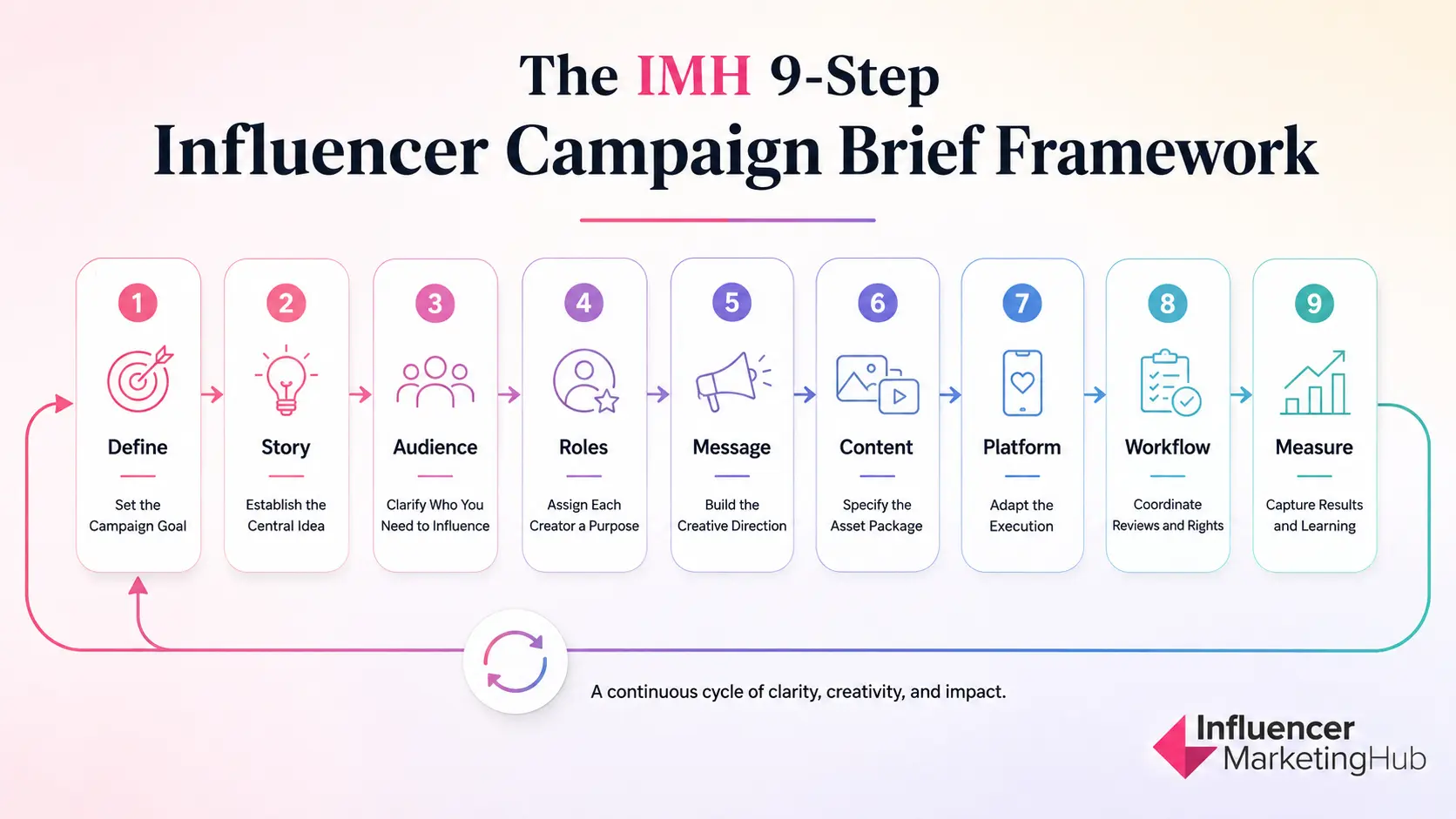
The strongest briefs are built by moving from campaign strategy to creator execution in a deliberate order.
The IMH framework organizes that process into nine stages.
| Step | Campaign Question | Output |
| 1. Define the Campaign | What must this campaign achieve? | Objectives, audience response, targets, and KPIs |
| 2. Establish the Campaign Story | What central idea should connect the content? | Campaign proposition and creative foundation |
| 3. Specify the Audience | Who must the creators influence? | Actionable audience profile |
| 4. Assign Creator Roles | What should each creator contribute? | Creator-role matrix |
| 5. Build the Message System | What must the audience understand, believe, or do? | Core takeaway, proof, hooks, and CTA |
| 6. Design the Content Package | What assets must the campaign produce? | Deliverable and asset plan |
| 7. Adapt for Each Platform | How should execution change by channel? | Platform-specific direction |
| 8. Set the Workflow and Guardrails | How will the work be approved, protected, and published? | Timeline, approvals, rights summary, and responsibilities |
| 9. Measure and Improve | How will results shape the next campaign? | Measurement and optimization plan |
📋 Build Your Influencer Campaign Brief Use the IMH Influencer Campaign Brief Template to turn the nine-step framework into a clear working document. Capture the campaign objective, audience, creator roles, messaging, deliverables, platform requirements, approvals, usage plans, and measurement approach in one place. Get the Influencer Campaign Brief
Step 1: Define the Campaign
Before you write the creator-facing brief, define what the campaign is expected to achieve.
This sounds obvious, but many briefs begin with product information, brand history, or content requirements before establishing the campaign’s purpose. Creators are then asked to produce assets without understanding what those assets are supposed to accomplish.
A stronger brief begins with the campaign objective and works backward from the audience response you want to create.
Start With the Business Objective
The business objective explains why the campaign exists.
Common objectives include increasing awareness, launching a new product, generating qualified traffic, driving sales, collecting reusable content, entering a new market, or strengthening brand consideration.
The campaign brief does not need to expose every internal commercial target, but the team creating it should agree on the priority before briefing creators.
An influencer marketing campaign designed to generate product discovery will require different creators, formats, and calls to action from one designed to increase conversions.
Translate the Business Goal Into an Influencer Campaign Objective
The influencer campaign objective should describe the specific contribution creator activity will make.
| Business Objective | Influencer Campaign Objective |
| Launch a new product | Introduce the product through relatable creator-led demonstrations |
| Increase awareness | Reach priority audiences through trusted creator voices |
| Generate demand | Help audiences understand the problem and explore the solution |
| Drive sales | Encourage qualified audiences to purchase through trackable creator content |
| Build trust | Use authentic experiences and proof to reduce uncertainty |
| Produce reusable assets | Generate creator content for organic, paid, and owned channels |
This distinction matters because “increase sales” is too broad to guide creative execution.
“Show how the product solves a recurring problem and direct viewers to a limited-time offer” gives the creator a clearer job.
Define the Desired Audience Response
The campaign objective explains what the brand wants to achieve. The audience response explains what needs to happen in the viewer’s mind before that outcome becomes possible.
A useful brief should state what the audience should:
- Understand
- Feel
- Believe
- Remember
- Do next
Keep this section focused. One campaign does not need five equally important audience responses.
For example:
This is more actionable than asking creators to “build awareness.”
You’ll often hear top creators ask: “Just tell me the one thing you want the viewer to do.”
@renreports 3 tips for influencer briefs #influencermarketingtips #influencermaketingstrategy #influencerbrieftemplate #influencerbrief #influencercampaignmanager #marketingbriefs #socialmediamarketingtips2023 ♬ original sound - renèe rodan
Choose One Primary KPI
The primary KPI should reflect the campaign’s central purpose.
| Campaign Goal | Primary KPI |
| Awareness | Qualified reach |
| Engagement | Meaningful interactions |
| Education | Video completion or engaged viewing |
| Traffic | Qualified landing-page visits |
| Lead generation | Completed forms or downloads |
| Sales | Attributed purchases or revenue |
| Content production | Approved reusable assets |
| Community growth | New qualified members or participants |
Supporting metrics can help explain performance, but they should not compete with the main measure of success.
A sales campaign may also track reach, engagement, clicks, and add-to-cart activity. However, attributed revenue or purchases should remain the primary KPI if that is the campaign’s intended outcome.
Set the Campaign Target and Timeframe
Targets give the campaign a clear scale.
Document the campaign period, launch date, content window, and expected result. This helps the team determine how many creators, assets, and publishing moments are required.
For example:
| Campaign Element | Example |
| Business objective | Increase product adoption |
| Influencer campaign objective | Generate qualified trials through creator demonstrations |
| Audience response | Recognize the product as an easier way to manage social workflows |
| Primary KPI | Qualified trials attributed to creator activity |
| Supporting KPIs | Landing-page visits, conversion rate, cost per trial |
| Campaign target | 500 qualified trials |
| Campaign period | September 1–October 15 |
This becomes the strategic foundation for the remaining sections of the brief.
Outcome: A defined campaign objective, audience response, KPI, target, and timeframe that give the creator program a clear purpose.
Step 2: Establish the Influencer Campaign Story
The campaign story is the central idea that connects every creator’s contribution.
It should explain what the campaign is about, why it matters to the audience, and why the product or offer belongs in that story.
This is not the same as a slogan or campaign tagline. A tagline may express the idea publicly, while the campaign story gives creators enough context to interpret it in their own voice.
Identify the Audience Tension
Strong campaign stories usually begin with a real audience tension.
The audience may want a result but feel blocked by time, cost, uncertainty, complexity, or lack of trust.
- For example:
The product can then enter the story as a credible response to that tension.
Without this connection, the brief may read like a product announcement rather than a campaign creators can build around.
Define the Campaign Proposition
The campaign proposition states the value the audience should take away.
It should be specific enough to guide content without becoming a required script.
| Weak Proposition | Stronger Proposition |
| Our product is easy to use | The product helps small teams plan, approve, and publish social content in one workflow |
| This bottle is sustainable | The bottle reduces single-use waste without compromising convenience or design |
| Our skincare is effective | The product simplifies a routine for people dealing with a specific skin concern |
| Our app saves time | The app removes a recurring task from the user’s weekly workflow |
The proposition should connect the audience problem to the product’s role in solving it.
Explain Why the Campaign Matters Now
Timing can shape the creative direction.
The campaign may be tied to a launch, seasonal behavior, cultural moment, industry shift, or changing audience need.
Briefly explain why the message is relevant during this campaign period.
- For example:
This gives creators a stronger reason for discussing the product now rather than presenting it as an isolated promotion.
Create One Shared Creative Foundation
The influencer campaign story should unify the work without making every creator produce the same narrative.
A simple campaign foundation can include:
| Story Element | Example |
| Audience tension | Social media planning becomes fragmented across too many tools |
| Campaign proposition | One connected workflow makes planning easier to manage |
| Product role | The platform brings planning, approval, scheduling, and reporting together |
| Desired emotion | Relief and confidence |
| Desired action | Explore the workflow and start a trial |
Creators can interpret this through tutorials, before-and-after stories, demonstrations, or personal experiences while still supporting the same central idea.
Keep Brand Background Relevant
Creators do not need a long company history unless it directly supports the campaign.
Include only the context that helps them understand the product, mission, audience, or reason for the collaboration.
A concise brand introduction should answer:
- What does the brand offer?
- Who does it serve?
- What makes this product or campaign relevant?
- Why is this creator a suitable partner?
Anything else should be linked as optional background material rather than placed in the main brief.
Outcome: A clear campaign story connecting the audience tension, product role, shared proposition, emotional direction, and desired action.
Step 3: Specify the Campaign Audience
Creators need to understand who they are speaking to before they can decide how to speak.
Broad labels such as “Gen Z,” “millennials,” “parents,” or “small-business owners” provide limited creative direction. They describe a group but do not explain what the audience needs, what they believe, or why they might respond to the campaign.
The brief should give creators an audience profile they can use when shaping the hook, example, proof, tone, and CTA.
Focus on the Priority Audience
A campaign may reach several groups, but the brief should identify the primary audience first.
This prevents creators from trying to speak to everyone at once.
For example:
This is more useful than “B2B marketers” because it gives the creator a recognizable situation to address.
Describe the Problem in the Audience’s Language
Explain the problem as the audience experiences it.
Internal marketing language may describe the issue as “workflow inefficiency.” The audience may describe it as:
Creator content will feel more relevant when it reflects the audience’s own language and circumstances.
Document the Motivation and Barrier
The audience profile should explain both why someone may want the product and why they may hesitate.
| Audience Insight | Example |
| Goal | Maintain a consistent social media presence |
| Problem | Planning and approvals are spread across several tools |
| Motivation | Save time and reduce missed deadlines |
| Barrier | Concern that adopting another platform will add complexity |
| Proof needed | A practical demonstration of the workflow |
| Desired action | Visit the campaign page and start a trial |
The barrier is especially important because it often determines what proof the creator needs to provide.
Explain Relevant Platform Behavior
The audience may behave differently across platforms.
On TikTok, they may respond to fast demonstrations or relatable workplace scenarios. On YouTube, they may want a detailed walkthrough. On LinkedIn, they may engage with practical frameworks, professional observations, or customer examples.
The brief should explain the relevant behavior rather than relying only on demographic fit.
Campaign Audience Example
| Area | Example |
| Priority audience | Marketing managers at companies with 20–200 employees |
| Main problem | Social media planning and approvals are fragmented |
| Desired outcome | Run a consistent program with clearer oversight |
| Main objection | Concern about adding another tool |
| Trust signal | A real workflow demonstration |
| Platform behavior | Uses LinkedIn for professional insight and YouTube for evaluation |
| Desired action | Visit the campaign page and start a trial |
| Creative implication | Lead with a relatable workflow problem, then demonstrate the simplified process |
Outcome: An actionable audience profile covering the priority segment, problem, motivation, objection, platform behavior, trust requirements, and desired action.
Step 4: Assign Creator Roles
Influencer campaigns become difficult to coordinate when every creator receives the same objective, message, and deliverable.
A campaign may involve several creators, but that does not mean they should all perform the same function. One creator may introduce the campaign to a broad audience, another may explain the product, and another may provide the proof needed to move people closer to action.
The campaign brief should make these roles explicit.
Define the Role Before the Deliverable
Start by deciding what each creator should contribute to the campaign.
The deliverable comes second.
A product demonstration only makes sense when the creator has been selected to educate or prove the product’s value. A high-reach lifestyle post may be appropriate for awareness but less useful when the campaign needs a detailed comparison or conversion-focused explanation.
| Creator Role | Main Contribution | Typical Content |
| Reach | Introduces the campaign to relevant new audiences | Lifestyle content, launch story, broad product introduction |
| Education | Helps audiences understand the product or problem | Tutorial, explainer, walkthrough |
| Demonstration | Shows how the product works in practice | Use case, routine, before-and-after, screen recording |
| Proof | Reduces uncertainty through experience or evidence | Review, testimonial, case study, results-led content |
| Conversion | Encourages a measurable next step | Offer-led post, product recommendation, direct CTA |
| Community | Starts discussion and encourages participation | Prompt, challenge, response content, live session |
These roles can overlap, but every creator should still have one primary purpose.
Match Creators to the Role They Can Perform Credibly
Creator selection should consider more than follower count and engagement rate.
The creator’s format, subject expertise, audience relationship, presentation style, and previous content all affect which role they can perform well.
A creator known for detailed tutorials may be a strong educator. A lifestyle creator with a highly engaged audience may be better suited to awareness or proof. A creator who regularly drives product discovery may be more appropriate for conversion.
The goal is to align the campaign need with the creator’s natural strengths.
One marketing manager described her process like this:
@bloggingwithzara Replying to @stressyspice walking through the influencer brief I use as a social media manager that hires influencers for the brand side! #influencermarketingtip #influencermanager #influencerbrief #socialmediamanagerjob #socialmediacareer #paidbranddeals #paidinfluencer ♬ original sound - Zara | Social Media Manager
On the surface, it’s a quality filter. But at a deeper level, it’s a way to test for creative fluency, tone alignment, and strategic fit before production even begins.
🧩 Turn the Campaign Direction Into a Creator-Specific Brief Once each creator has a defined campaign role, use the IMH Influencer Brief Builder to personalize the shared direction. Adapt the campaign message, deliverables, platform requirements, examples, deadlines, and approval process to the creator’s audience and content style. Get the Influencer Brief Builder
Step 5: Build the Influencer Campaign Message System
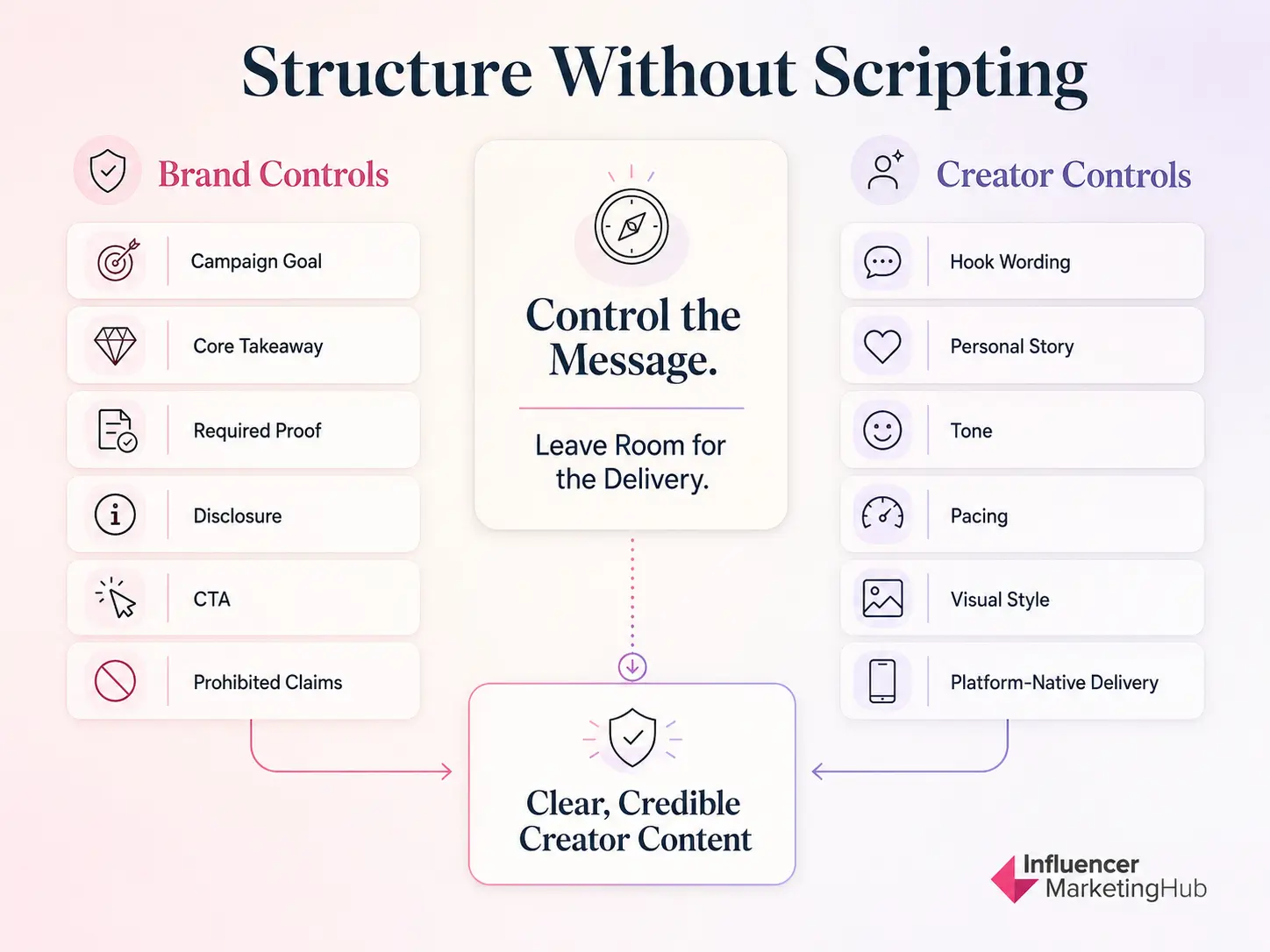
The influencer campaign message system defines what every creator needs to communicate while preserving their ability to decide how to communicate it.
This is the section where many briefs become either too vague or too controlling.
A vague brief may provide a slogan, hashtag, and product link without explaining what the audience should understand. An overly restrictive brief may prescribe every word, shot, and facial expression.
A better approach is to define the message architecture rather than write the creator’s script.
Start With One Core Takeaway
The core takeaway is the single idea the audience should remember after seeing the content.
It should be clear, specific, and connected to the campaign objective.
For example:
This is stronger than a broad statement such as “The platform makes social media easier.”
The core takeaway should remain consistent across the campaign, even when creators interpret it through different stories and formats.
Build the Message Around Four Layers
A practical campaign message system can be organized into four parts:
Core takeaway → Hook territory → Proof → CTA
| Message Layer | Purpose | Example |
| Core takeaway | Defines what the audience should remember | One workflow replaces several disconnected tools |
| Hook territory | Suggests how the creator may introduce the problem | “Here is where our content approval process kept breaking” |
| Proof | Shows why the audience should believe the message | Demonstration of planning, approval, and scheduling |
| CTA | Defines the next action | Visit the campaign page and start a trial |
This gives creators a usable structure without requiring identical content.
Separate Required Messages From Supporting Points
Not every product feature needs to appear in every asset.
The brief should distinguish between the message that must be communicated and the supporting points creators may use when relevant.
| Message Type | How to Use It |
| Core message | Must be clear in every creator execution |
| Required proof point | Must be shown or explained when relevant to the deliverable |
| Optional supporting point | May be used when it fits the creator’s story |
| Prohibited claim | Must not be used |
| Creator interpretation | Left to the creator’s voice, pacing, and examples |
This hierarchy reduces clutter and prevents creators from trying to force several competing messages into one short piece of content.
Give Hook Territories, Not Mandatory Opening Lines
Hooks matter, but requiring every creator to use the same sentence often produces repetitive and unnatural content.
Instead, provide several hook territories.
For a workflow platform, these might include:
| Hook Territory | Creative Direction |
| Frustration | Show a recurring approval or planning problem |
| Discovery | Introduce the feature that changed the process |
| Comparison | Contrast the old workflow with the new one |
| Confession | Share a mistake or inefficiency the creator used to accept |
| Demonstration | Begin directly with the product in action |
The creator can then translate the territory into language that fits their audience.
In one creator’s breakdown of a Starbucks campaign, she walked through how the brand gave her the hook, the visual, and even the caption:
“Hook: ‘This Starbucks hack is a game changer’
Visual: Me grabbing the coffee, smiling
Caption: ‘Finally, an affordable way to have Starbucks.’”
@ravinascreatives Let’s talk about creative briefs. #ugc #ugcterms #ugctips #microinfluencertips #nanoinfluencertips #creativebrief #contentcreatortips2022 #ugcexample #branddeals ♬ original sound - ravinascreative
This approach helps creators execute faster while still using their voice.
Define the Proof the Campaign Needs
Claims become more credible when the creator can show the audience why they should believe them.
Proof may come from:
- A visible product demonstration
- A real before-and-after
- A specific use case
- Personal experience
- Customer evidence
- Product functionality
- A relevant statistic approved by the brand
The brief should state what type of proof is required without dictating every scene.
For example:
That is more useful than telling the creator to “show the dashboard.”
Match the CTA to the Creator’s Role
Not every creator needs the same CTA.
A reach creator may encourage the audience to explore the launch. An educator may direct viewers to a full guide or product page. A conversion creator may use a tracked offer or purchase link.
| Creator Role | Appropriate CTA |
| Reach | Learn more or follow the campaign |
| Education | Explore the feature or watch the full walkthrough |
| Demonstration | Visit the product page |
| Proof | Read more reviews or see the results |
| Conversion | Purchase, register, or start a trial |
| Community | Comment, respond, or participate |
The CTA should match both the campaign stage and the audience’s likely readiness.
Define the Emotional Direction
The brief can also state how the campaign should feel.
This may include relief, curiosity, confidence, excitement, reassurance, or urgency.
Avoid vague instructions such as “make it fun” or “keep it authentic.” Explain what emotional response should support the campaign story.
For example:
This gives the creator a clearer emotional target.
Step 6: Design the Creator Content Package
Once the campaign message and creator roles are clear, define exactly what the campaign needs each creator to produce.
This is more than listing a post type and due date. A strong influencer campaign brief should explain the full asset package, including the published content, supporting files, platform variations, and any reusable material the brand expects to receive.
The goal is to remove ambiguity before production begins.
Define the Deliverable by Purpose
Start with the role assigned to the creator, then choose the deliverable that best supports it.
A creator responsible for education may need a tutorial or walkthrough. A creator responsible for proof may be better suited to a review, demonstration, or before-and-after narrative. A conversion creator may need a shorter offer-led asset with a clear CTA.
The brief should make the connection between the creator’s role and the requested content obvious.
Specify the Full Deliverable
Avoid descriptions such as “one TikTok” or “three Stories.”
A complete deliverable should state the platform, format, quantity, duration, aspect ratio, required elements, publication status, and supporting files.
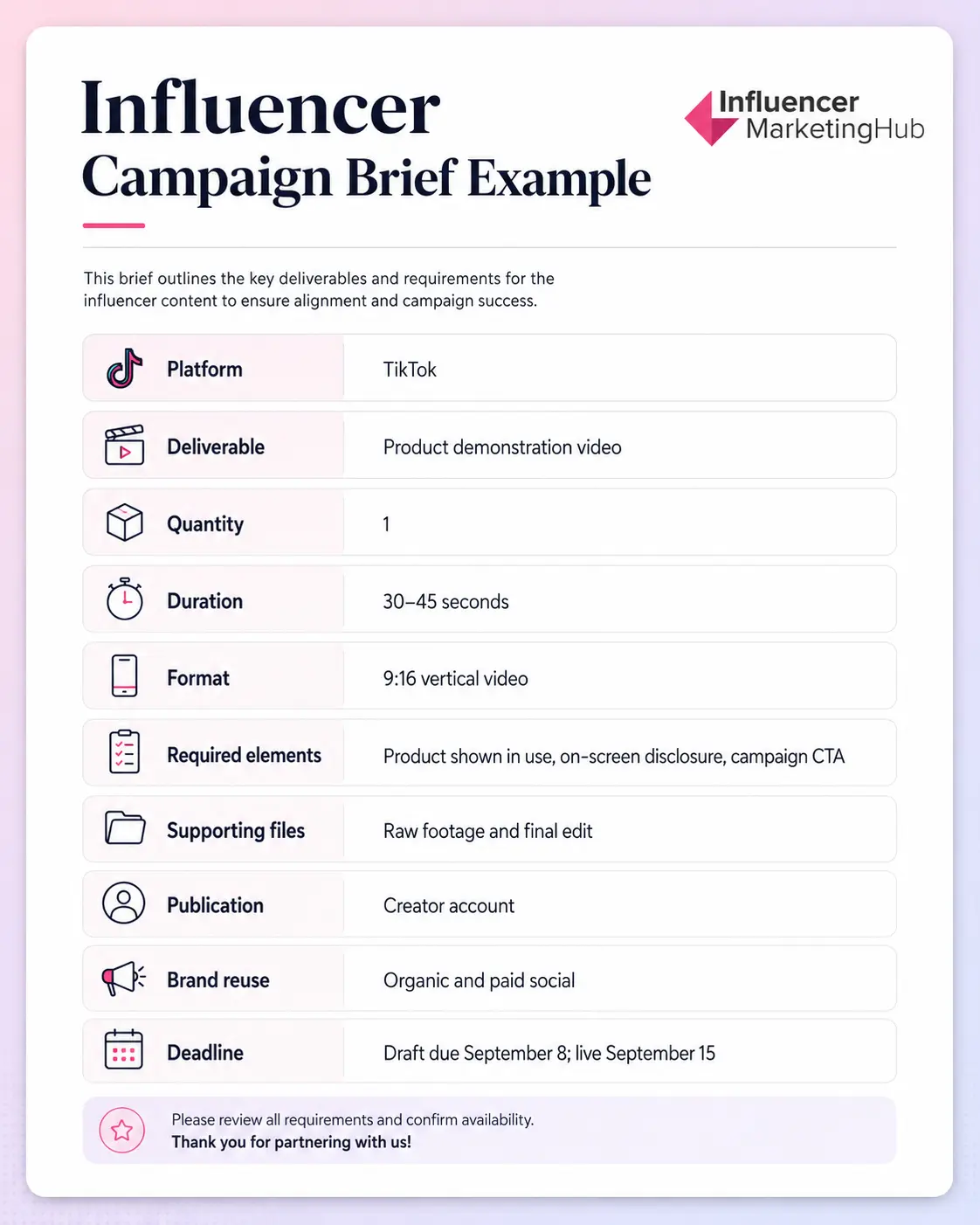
This level of detail reduces the risk of receiving an asset that looks good but cannot be used as planned.
Distinguish Published Content From Supporting Assets
The final post may be only one part of the campaign package.
The brand may also require raw footage, still images, alternative hooks, clean versions without music, shorter edits, or caption variations.
| Asset | Purpose |
| Final edited video | Creator publication |
| Raw footage | Brand editing and future cutdowns |
| Clean version | Paid social or cross-platform use |
| Alternative hook | Creative testing |
| Still images | Email, product page, or organic posts |
| Caption copy | Approval and publication |
| Thumbnail | YouTube or campaign landing page |
| Story frames | Reminder or conversion support |
These requirements should be agreed before pricing and production. Additional asset requests made after delivery can create friction and may require new compensation.
Define Raw and Edited File Requirements
If the brand needs raw footage, explain what “raw” means.
It may refer to unedited clips, files without text overlays, versions without copyrighted audio, or the complete recording before cuts.
The brief should also state the preferred file type, resolution, orientation, upload destination, and naming convention.
For example:
Clear file instructions make downstream editing and version control much easier.
Plan for Creative Variations
Campaigns often need more than one version of the same idea, especially when creator content will be used in paid media.
Possible variations include a different opening hook, shorter cutdown, alternate CTA, product-focused version, testimonial-led version, or clean edit for brand reuse.
The brief should explain why the variation is needed.
For example:
This gives the creator context and prevents the request from feeling like unnecessary duplicate work.
Build the Campaign Deliverables Matrix
For multi-creator campaigns, bring every asset into one table.
| Creator | Role | Platform | Deliverable | Quantity | Supporting Assets | Draft Due | Live Date |
| Creator A | Reach | Lifestyle Reel | 1 | 3 Story frames | Sept. 5 | Sept. 12 | |
| Creator B | Education | YouTube | Product tutorial | 1 | Thumbnail and raw footage | Sept. 7 | Sept. 16 |
| Creator C | Demonstration | TikTok | Workflow demo | 2 | Clean edits and alt hooks | Sept. 8 | Sept. 14 |
| Creator D | Proof | Review Reel | 1 | 5 still images | Sept. 10 | Sept. 18 | |
| Creator E | Conversion | TikTok | Offer-led video | 1 | Alternate CTA version | Sept. 12 | Sept. 20 |
This matrix helps the team see whether the campaign has enough variety across roles, formats, and stages of the audience journey.
Connect the Content Package to Reuse
If creator content will support paid, organic, email, ecommerce, or landing-page activity, the production requirements should reflect those uses.
A video intended for paid social may need a clean version without copyrighted audio. A product-page asset may need a tighter demonstration and visible packaging. An email image may need more negative space for copy.
The earlier the brand defines these needs, the more efficiently the creator can capture them.
Outcome: A complete creator content package covering published deliverables, supporting assets, formats, specifications, variations, deadlines, and planned reuse.
Step 7: Adapt the Influencer Campaign Brief for Each Platform
One creator campaign can carry a consistent message across several platforms, but the execution should not be identical.
Each platform has different content formats, audience behaviors, discovery systems, and conversion paths. The campaign brief should therefore explain how the shared idea needs to change by channel.
This is not about forcing creators to follow a universal formula for TikTok, Instagram, YouTube, or LinkedIn. It is about making sure the content feels natural in the environment where it will appear.
Start With the Platform’s Role
Return to the role assigned to each platform in the campaign.
TikTok may be used for discovery and demonstration. YouTube may support deeper education. Instagram may combine awareness, visual proof, and Stories-based conversion. LinkedIn may be more useful for professional expertise or B2B consideration.
| Platform | Possible Campaign Role |
| TikTok | Discovery, demonstration, creator-led storytelling |
| Instagram Reels | Awareness, lifestyle integration, visual proof |
| Instagram Stories | Reminder, link clicks, offer support |
| YouTube Shorts | Short-form education and discovery |
| Long-form YouTube | Detailed evaluation, tutorial, or review |
| Professional education, authority, B2B demand | |
| Search-led inspiration and evergreen discovery |
The platform role should shape the format, CTA, and level of detail requested.
Adapt the Hook
The opening should match how audiences encounter content on that platform.
A short-form video may need to establish the problem or visual payoff immediately. A long-form YouTube video can spend more time explaining context. A LinkedIn post may begin with a professional observation, result, or contrarian insight.
The campaign brief should describe the hook territory rather than provide a fixed sentence.
Adjust the Level of Detail
The same product benefit may require different treatment across formats.
A short Reel might show one use case. A YouTube tutorial may explain the full process. Stories may focus on a reminder, personal recommendation, and link. A LinkedIn post may connect the product to a wider operational challenge.
Do not ask a 20-second video to communicate the same amount of information as a detailed tutorial.
The brief should identify the one message that matters most for each asset.
Match the CTA to the Platform
The desired action should be realistic within the platform experience.
| Platform | Possible CTA |
| TikTok | Visit the link in bio, search the product, or use a code |
| Instagram Reel | View the profile link, product tag, or Story follow-up |
| Instagram Stories | Tap the link sticker or reply |
| YouTube | Use the description link or pinned comment |
| Visit the campaign page, download a resource, or register | |
| Click through to the product or campaign page |
The brief should specify the exact link, code, product tag, or destination and confirm who is responsible for testing it.
Clarify Platform-Specific Specifications
Technical requirements should be stated clearly but kept separate from creative direction.
Depending on the platform, this may include duration, aspect ratio, caption limits, thumbnail requirements, link placement, safe zones, disclosure placement, or music restrictions.
A compact platform table can make these requirements easier to use.
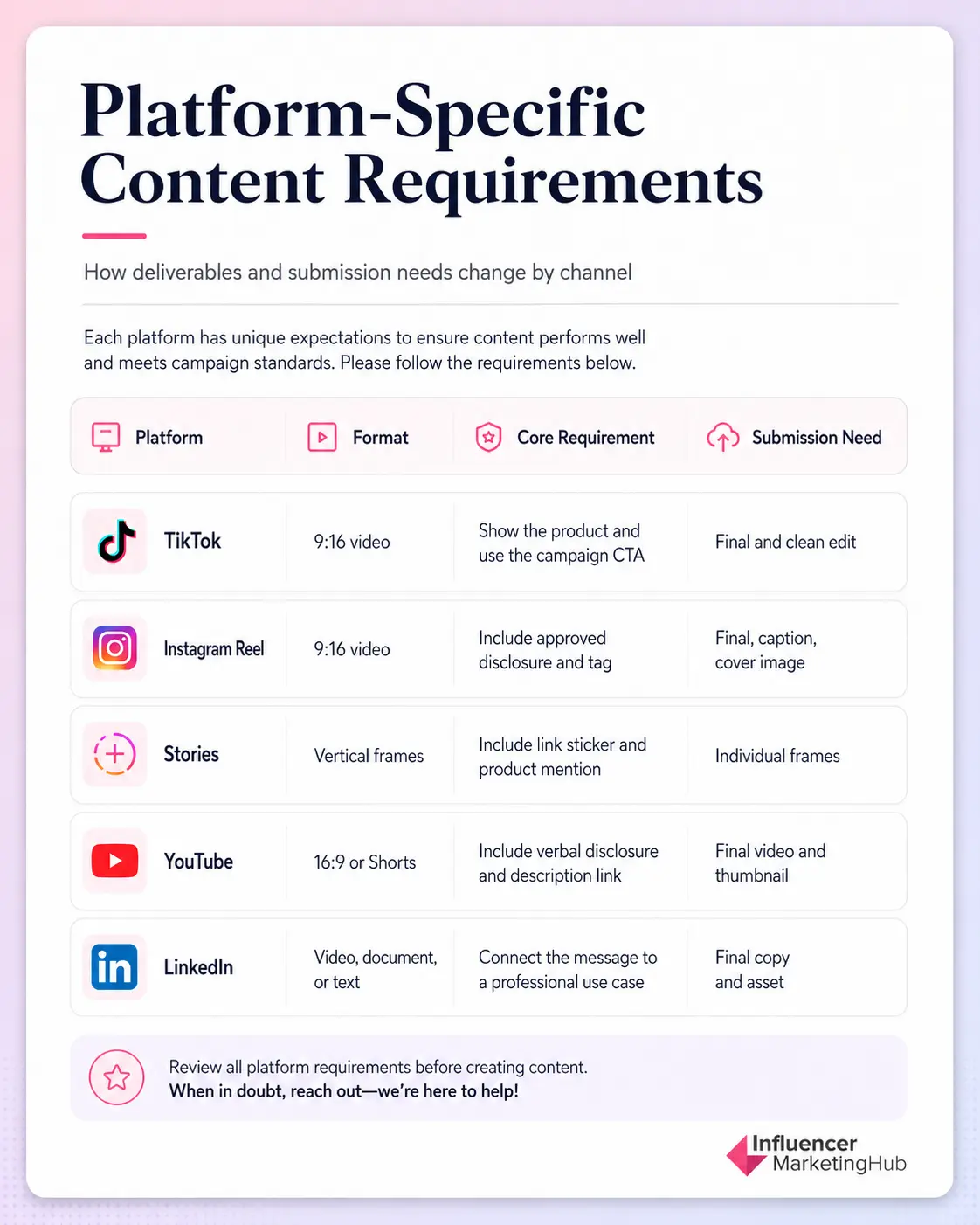
The exact requirements should reflect the selected creator, campaign, and current platform capabilities.
Outcome: A platform-specific execution plan covering role, hook, level of detail, format, CTA, technical requirements, and measurement.
Step 8: Set the Workflow and Campaign Guardrails
A strong influencer campaign brief should explain not only what creators need to produce, but also how the work will move from concept to publication.
Without a defined workflow, campaigns often lose time in the spaces between deliverables. Concepts sit unreviewed, feedback arrives from several stakeholders, creators receive conflicting instructions, and publication dates shift because no one knows who has final approval.
The brief should make the operating process visible before production begins.
Map the Campaign Workflow
Start by documenting the full sequence of work.
A typical process may look like this:
Brief shared → Creator questions → Concept submitted → Concept approved → Draft delivered → Feedback returned → Final approved → Content published → Performance reported
Each stage should have an owner, deadline, and expected output.
| Workflow Stage | Creator Responsibility | Brand Responsibility |
| Brief review | Read the campaign direction and raise questions | Provide complete assets and clarify requirements |
| Concept submission | Share the proposed hook, structure, proof, and CTA | Review strategic alignment |
| Production | Create the agreed content | Remain available for essential questions |
| Draft submission | Deliver the content in the required format | Review against the approved brief |
| Revisions | Address agreed feedback | Consolidate comments into one response |
| Final approval | Submit the completed asset | Confirm approval or identify remaining issues |
| Publication | Post within the approved window | Confirm links, tags, codes, and tracking |
| Reporting | Share agreed performance data | Review campaign and creator results |
This table gives creators a clear picture of what will happen after the brief is sent.
Set Realistic Deadlines
A publication date alone is not enough.
The brief should include the dates for product delivery, concept submission, concept approval, draft delivery, feedback, revision, final approval, and publication.
For example:
| Milestone | Date |
| Brief shared | September 1 |
| Creator questions due | September 3 |
| Concept submitted | September 5 |
| Concept approved | September 7 |
| Draft delivered | September 12 |
| Feedback returned | September 14 |
| Final asset delivered | September 17 |
| Content published | September 20 |
Build in enough time for genuine review and production.
A campaign that gives the creator four days to film but takes the brand a week to return feedback creates avoidable pressure and may undermine the relationship.
Clarify the Concept-Approval Process
Concept approval helps the brand catch strategic problems before the creator begins filming.
The concept submission does not need to be a full script. It may include the proposed opening, content structure, product demonstration, setting, proof point, and CTA.
For example:
The brand should review whether the concept supports the campaign objective and message system.
It should not use concept approval to rewrite the creator’s vocabulary or force unnecessary production decisions.
Set Revision Expectations
The campaign brief should state how many revision rounds are included and what each round may cover.
A revision should usually address missed requirements, incorrect information, disclosure issues, agreed creative changes, or technical problems.
It should not become an opportunity to replace the approved concept with a completely different idea after filming.
For example:
The scope includes one consolidated revision round covering factual accuracy, required campaign elements, disclosure, and alignment with the approved concept.
Requests outside that scope may require a new timeline, deliverable, or fee.
Create a Version-Control System
Campaigns become difficult to manage when several files are labelled “final.”
Set a naming convention that identifies the creator, platform, deliverable, and version.
For example:
CreatorName_TikTok_ProductDemo_V1
CreatorName_TikTok_ProductDemo_Final
The brief should also identify the official submission folder or review platform. Email attachments and private-message uploads make it easier for outdated versions to remain in circulation.
Confirm Publication Requirements
Before content goes live, clarify the approved publication window, caption, tags, link, discount code, disclosure, product tag, and any embargo.
The brief should also explain what happens when the creator cannot publish as planned.
For example:
Contact the campaign manager as soon as a delay becomes likely. Do not publish outside the approved window without confirmation.
This protects coordinated launches while giving the team time to adjust the wider campaign calendar.
Outcome: A complete campaign workflow covering milestones, concept approval, feedback, revisions, version control, publication, responsibilities, and escalation.
Step 9: Measure and Improve the Campaign
An influencer campaign brief should tell creators what success looks like before content is produced.
Measurement should not be added after publication or reduced to a list of every metric available on the platform. It should connect the campaign objective, creator role, content format, and desired audience action.
Start With the Campaign-Level KPI
Return to the primary KPI defined in Step 1.
This is the metric used to judge whether the campaign achieved its main purpose.
| Campaign Objective | Primary KPI |
| Introduce a new product | Qualified reach |
| Build consideration | Engaged views or campaign-page visits |
| Generate leads | Completed forms or downloads |
| Drive sales | Attributed purchases or revenue |
| Produce reusable content | Approved assets suitable for reuse |
| Strengthen community | Meaningful participation or recurring engagement |
The campaign may track several supporting metrics, but they should help explain the main result rather than compete with it.
Measure Creators According to Their Roles
A reach creator and a conversion creator should not be judged using the same scorecard.
| Creator Role | Primary Metric | Supporting Metrics |
| Reach | Qualified reach | Views, audience growth, frequency |
| Education | Engaged viewing | Watch time, completion rate, saves |
| Demonstration | Qualified traffic | Clicks, product-page visits, comments |
| Proof | Consideration signals | Saves, shares, positive sentiment |
| Conversion | Attributed action | Purchases, trials, leads, revenue |
| Community | Participation | Responses, entries, discussion quality |
This produces a fairer evaluation and helps the team understand how each creator contributed to the campaign.
Define the Tracking Method
The brief should state how the brand will connect creator activity to results.
Depending on the campaign, this may include tracked links, creator codes, affiliate links, landing pages, platform analytics, brand-lift studies, paid-media reporting, or post-purchase surveys.
Document who creates the tracking assets, where the creator should place them, and how they will be tested before publication.
For example:
Specify Reporting Requirements
Creators should know what performance information they need to provide and when.
The brief may request platform screenshots, views, reach, watch time, engagement, link clicks, audience demographics, Story completion, or sales attributed to a code.
Keep the request proportionate to the campaign and creator role.
A reporting table may look like this:
| Reporting Point | Data Required |
| 24 hours after publication | Views, reach, engagement, link activity |
| 7 days after publication | Updated performance and audience data |
| End of campaign | Final platform metrics and creator observations |
This gives the team a consistent reporting window without asking creators for repeated manual updates.
Capture Creator Feedback
Creators can provide useful insight into how the brief worked.
After the campaign, ask whether the direction was clear, which requirements were difficult to interpret, what audience reactions stood out, and what they would change in a future version.
This turns the creator into a source of campaign learning rather than only a content supplier.
Outcome: A measurement and learning process connecting campaign KPIs, creator roles, tracking, reporting, content reuse, feedback, and future briefing decisions.
Summarize Rights, Disclosures, and Payment Logistics
Influencer campaign briefs often include legal and commercial information, but they should not replace the signed agreement.
The brief should summarize the practical requirements creators need during execution. The contract should contain the binding terms.
Explain the Content Usage Plan Clearly
Creators should know where their work may appear after publication.
A practical summary might state:
This is clearer than broad wording such as “content may be used across marketing.”
The brief should also state whether the brand plans to crop, shorten, caption, remix, or combine the creator’s work with other assets.
Clarify Paid Amplification
When the campaign includes creator licensing, allowlisting, partnership ads, or brand-run paid media, explain the planned setup.
The brief should clarify which account will run the ads, how long the paid activity is expected to continue, whether alternative hooks are required, and whether the creator will review final paid edits.
The contract should still define the formal permission and compensation.
State the Disclosure Requirements
Disclosure instructions should be specific enough to use.
The brief should explain:
- The approved disclosure language
- Whether it must appear verbally, visually, or in the caption
- Where it should appear
- Which platform partnership tools must be used
- Who to contact if the creator is unsure
Avoid placing the disclosure at the end of a long caption or hiding it among unrelated hashtags.
The exact legal requirements may vary by market, platform, and campaign, so the brief should use the instructions approved for that collaboration.
Summarize Exclusivity in Practical Terms
If the campaign restricts competing partnerships, creators need to understand which brands or product categories are covered and for how long.
For example:
The signed agreement should define the formal category and exceptions.
Explain Payment Logistics
The brief may summarize the operational process without duplicating the contract.
Include the invoice contact, required documentation, payment trigger, expected processing period, and the person responsible for payment questions.
For example:
This helps the creator understand the workflow while keeping the binding payment terms in the contract.
Outcome: A practical summary of content usage, paid amplification, disclosure, exclusivity, and payment logistics that supports execution without replacing the legal agreement.
Common Briefing Mistakes That Derail Campaigns
At scale, the cost of a weak influencer campaign brief is missed timelines, strained creator relationships, broken messaging, and ultimately underperforming campaigns. These are the briefing missteps that senior marketers can't afford.
Mistake 1: Overprescribing the Creative
When marketers try to write the content for the influencer, you get robotic, lifeless posts. Too often, brands try to micromanage influencer content and ultimately strip creators of the authenticity that makes their voice resonate in the first place.
But the truth is, the magic of influencer marketing lies in strategic freedom.
When creators are handed scripts, what you get are lifeless promos. What they need instead is to interpret your message in a way that feels native to their audience.
HypeTrain sets a clear reminder of why flexible briefs drive performance in this post:
@hypetrain.io Influencer Brief Guide: 4 tips to success. #marketingtips #creativebrief #influencerbrief #brandcollaboration #influencermarketing #influencermanagement #influencermarketingagency #influencermarketingtips #influencermarketingcampaign #authorsoftitktok #hypetrain ♬ original sound - hypetrainio
Mistake 2: Prioritizing Internal Marketing Logic Over Creator Flow
Too often, briefs are built using inside-out thinking. But creators operate in an outside-in economy, where resonance drives reach, not rationale.
This is a failure of narrative-market fit: when the brand’s message architecture isn’t translatable into creator-native language.
Instead of pushing campaign logic downstream, apply contextual layering, mapping your core message to a creator’s lived experience, channel format, and emotional cadence. Think of it as message modularity: same strategic intent, reassembled through the creator’s POV.
Mistake 3: Sending “One-Size-Fits-All” Briefs to All Creators
Templated creator briefs overlook the influence supply chain. A macro creator with high editorial equity should never receive the same structure as a UGC creator positioned for performance testing.
@dillie_beyond_beauty Sarah Jannetti, Founder of Content Recipe, explains how her AI solution creates customized briefs that help brands and influencers prioritize authenticity, utility, and trust. #contentbrief #influencermarketing #influenceroutreach #contentrecipe #socialcommerce #creatoreconomy ♬ original sound - dilliebeyondbeauty
Mistake 4: Leaving Deliverables Vague
Vagueness leads to delay. Creators don’t know what format, what aspect ratio, how many drafts, or how the content will be used. At its core, this is a brief integrity issue: the more ambiguous your specs, the more likely your campaign suffers from revision churn, legal bottlenecks, and post-production misalignment.
Marketers often assume flexibility = creativity, but in the creator economy, it often results in format friction, where even minor uncertainties (16:9 or 9:16? Draft review process?) delay workflows and dilute brand control.
The fix? Operationalize spec clarity as a service design principle: define deliverables using modular components—format, CTA, rights usage, timeline—so every party knows exactly what’s being built.
Mistake 5: Ignoring Platform-Native Expectations
Posting the same content across TikTok, Reels, and YouTube Shorts? That’s a platform mismatch waiting to happen.
Each platform is its own cultural arena, governed by unique algorithms, user behaviors, and content semiotics.
When you post a TikTok-native trend edit onto YouTube Shorts, you’re not just misfiring stylistically; you’re misaligning with the emotional cadence of the platform. Great marketers decode and re-encode their message to meet the implicit grammar of each ecosystem. This isn’t just about aesthetics—it’s about earning algorithmic fluency and cultural legitimacy.
Mistake 6: Failing to Show Examples of Past Success
Too many briefs lack performance anchoring, leaving creators in the dark about what actually drove ROI.
Without visibility into past top-performers, they’re forced to guess the creative variables that matter. Sharing high-performing examples is a core part of your creative intelligence system.
Think of it as training data: the more pattern-rich context you provide, the higher the odds of repeatable success. It also builds trust. When you open the black box and show creators what “good” looks like (and why), you’re not just briefing them—you’re enrolling them in your performance culture.
Turn Campaign Strategy Into Better Creator Work
An influencer campaign brief should make the campaign easier to understand and easier to execute.
It gives the internal team one approved direction, shows creators how their work contributes, and reduces ambiguity around messaging, deliverables, approvals, reuse, and measurement.
The strongest briefs provide structure without attempting to manufacture authenticity. They protect essential campaign requirements while giving creators enough room to communicate in a way their audiences already trust.
Use the nine-step IMH framework to build the shared campaign foundation first. Then adapt that direction into creator-specific briefs based on each participant’s role, platform, content style, and deliverables.

SUGGESTED

Briefing Macro vs. Micro Influencers: What Actually Changes? (+ Free Brief Builder)
Still using the same brief for all creators? Discover why a one-size-fits-all template...

Influencer Outreach Strategy: How to Build a Campaign That Creators Actually Respond To (+ Free Templates)
Learn how to build an influencer outreach strategy that improves response rates builds...

How to Use Social Listening to Write Creator Briefs That Power Winning Campaigns
Turn noisy social data into clear creative hooks using emotion-topic mapping filtered...