Most professionals don't think about their bio until someone asks for it.
A conference organizer needs your speaker profile. A client requests a short introduction for a proposal. Your company launches a new team page. You're invited to contribute a guest article or appear on a podcast.
Suddenly, you're faced with the challenge of summarizing your experience, expertise, and personality in just a few sentences.
Writing a professional bio is harder than it looks. It needs to establish credibility without sounding boastful, communicate your value without becoming a résumé, and leave readers with a clear understanding of who you are and what you do.
Whether you're writing a LinkedIn summary, Instagram bio, company profile, website introduction, or speaker bio, the same challenge remains: deciding what to include and what to leave out.
This guide walks you through the complete process for writing a polished professional bio from scratch. Along the way, you'll find professional bio examples, editable templates, and practical writing tips to help you create a bio you can confidently adapt for different professional situations.
- What Is a Professional Bio?
- What Makes a Great Professional Bio?
- The IMH Professional Bio Writing Framework
- Professional Bio Examples
- Professional Bio Templates
- First Person vs. Third Person: Which Should You Use?
- How Long Should a Professional Bio Be?
- Write It Once. Adapt It Everywhere.
- Frequently Asked Questions
Write Your Professional Bio With the IMH Bio Template Toolkit
Creating a professional bio becomes much easier when you have a structured process to follow. The IMH Professional Bio Toolkit includes everything you need to write, refine, and reuse your bio across different professional settings.
The toolkit includes:
- Professional Bio Builder: A guided workbook that walks you through each stage of writing your bio, from defining your audience to producing a polished final draft.
- Professional Bio Template Library: A collection of editable templates for LinkedIn, company profiles, personal websites, speaker bios, author pages, freelancer profiles, and more.
Whether you're writing your first professional bio or updating one that's years out of date, these resources will help you create a stronger bio faster, and adapt it wherever you need it.
What Is a Professional Bio?
A professional bio is a short introduction that summarizes who you are, what you do, and why someone should trust your expertise. Unlike a résumé, which lists your work history in detail, a professional bio tells your professional story in a concise, engaging way that helps readers quickly understand your background and the value you bring.
Professional bios are used across a wide range of business and networking situations. You might include one on your LinkedIn profile, personal website, company team page, conference speaker profile, guest article, proposal, portfolio, or author page.
Although the wording and length may vary depending on the context, the goal remains the same: introduce yourself in a way that's credible, relevant, and memorable.
It's also easy to confuse a professional bio with other forms of self-introduction. While they may overlap, each serves a different purpose.
| Content Type | Primary Purpose | Typical Length | Common Uses |
| Professional Bio | Introduce your expertise and build credibility | 50-150 words | LinkedIn, websites, speaker profiles, company pages |
| Résumé Summary | Highlight qualifications for a specific job | 2-5 sentences | Résumés and CVs |
| About Me Section | Share a broader personal and professional story | 150-500 words | Personal websites, portfolios, blogs |
| Personal Biography | Tell a detailed life or career story | Several paragraphs or pages | Books, media kits, historical profiles |
Understanding these differences makes it much easier to write the right type of introduction for the situation instead of trying to use the same copy everywhere.
What Makes a Great Professional Bio?
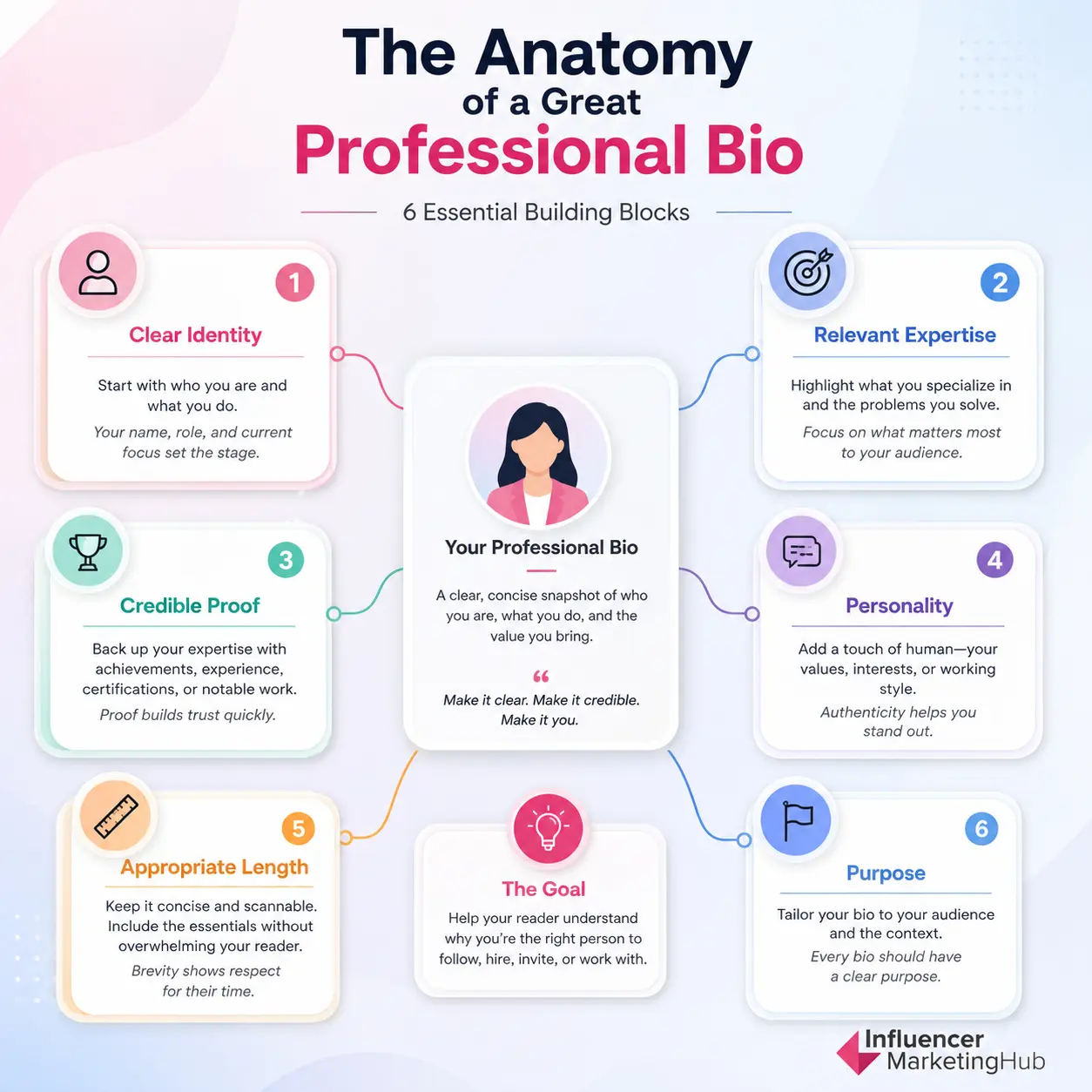
Strong professional bios aren't defined by impressive job titles or long lists of accomplishments. They're defined by clarity. In just a few sentences, readers should understand what you do, who you help, why you're qualified, and what makes your approach distinctive.
The most effective bios are written for the reader rather than the writer. Instead of trying to include every achievement, they focus on the information that helps the audience quickly understand why the person behind the bio is worth knowing, hiring, inviting, or working with.
A well-written professional bio typically includes six key elements.
| Element | Why It Matters |
| Clear Identity | Immediately tells readers who you are and your professional role. |
| Relevant Expertise | Explains what you specialize in and who you help. |
| Credible Proof | Supports your expertise with achievements, experience, certifications, or notable work. |
| Personality | Adds authenticity through values, interests, or working style without overshadowing your professional identity. |
| Appropriate Length | Includes enough information to establish credibility without overwhelming the reader. |
| Purpose | Matches the audience and context, whether it's a LinkedIn profile, speaker page, company website, or portfolio. |
The strongest bios strike a balance between professionalism and personality. They communicate expertise through specific, relevant details rather than generic adjectives, making them more memorable and more credible.
The IMH Professional Bio Writing Framework
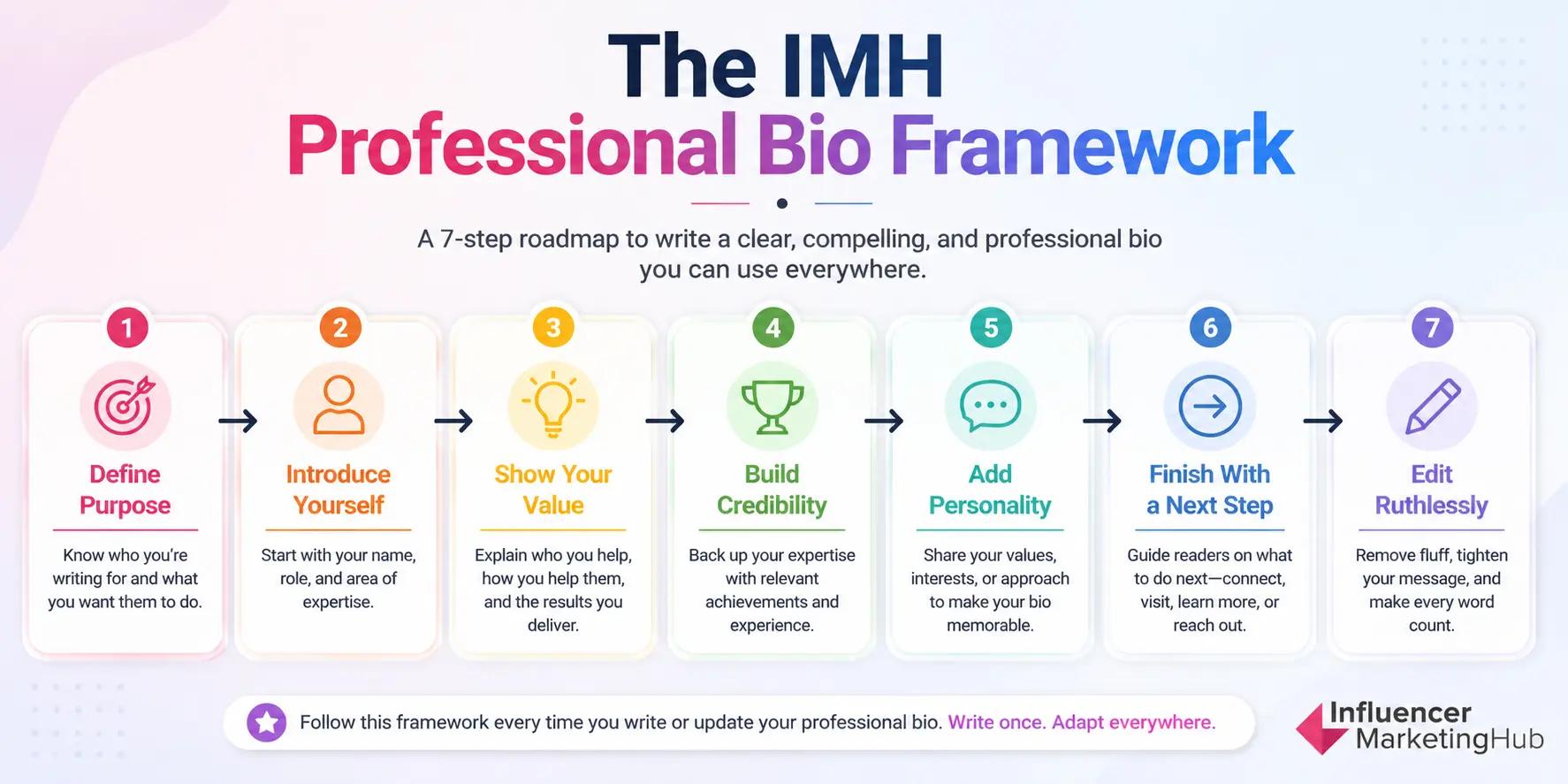
Most people don't struggle to write a professional bio because they lack experience. They struggle because they try to summarize an entire career in a few sentences without first deciding what actually matters.
The IMH Professional Bio Framework breaks the writing process into seven practical steps. Instead of trying to write your bio from beginning to end in one sitting, you'll make one decision at a time, building a polished introduction that's easy to adapt for LinkedIn, company websites, speaker profiles, portfolios, and other professional settings.
Step 1: Define Your Purpose
Before writing a single sentence, decide why you're writing the bio and who will read it. A bio for a conference speaker should emphasize expertise and credibility, while a LinkedIn bio may focus more on your career journey and professional interests. Starting with the wrong purpose often leads to including information that isn't relevant to your audience.
Ask yourself three simple questions before you begin:
- Who is this bio for?
- Where will it be published?
- What should readers know or do after reading it?
The answers become your filter. If a detail doesn't support your objective, it probably doesn't belong in your bio.
Example
- Audience: Potential clients
- Purpose: Introduce consulting services
- Desired Outcome: Encourage readers to book a discovery call
Step 2: Introduce Yourself Clearly
The opening sentence sets the tone for everything that follows. Readers should immediately understand who you are and what you do without having to interpret vague language or industry jargon.
Start with the basics: your name, current role, area of expertise, and, where relevant, your organization or business. Keep the introduction specific rather than relying on broad statements such as "passionate marketing professional" or "results-driven leader."
Example
- Jordan Rivera is a content strategist who helps B2B SaaS companies create SEO-driven content that attracts qualified leads.
In one sentence, readers know who Jordan is, what they do, and who they help.
Step 3: Explain the Value You Provide
Listing responsibilities doesn't explain why someone should work with you. Instead, focus on the value your work creates.
Think beyond your job title and describe the problems you solve, the audiences you serve, or the outcomes you help achieve. Readers should finish this section understanding not only what you do, but why your work matters.
Example
- She works with growing software companies to develop content strategies that improve search visibility and generate qualified pipeline.
This approach is more meaningful than simply stating, "She manages content marketing."
Step 4: Build Credibility
Once readers understand what you do, give them a reason to trust your expertise. Credibility comes from specific proof rather than broad claims.
Choose one or two pieces of evidence that best support your professional identity. Depending on your experience, that might include years in your industry, certifications, awards, measurable achievements, notable clients, published work, speaking engagements, or academic qualifications.
Quality matters more than quantity. A single relevant accomplishment often carries more weight than a long list of unrelated credentials.
Example
- Over the past eight years, Jordan has helped technology companies increase organic traffic through content strategies built around search intent and customer education.
Step 5: Add Personality
Professional doesn't have to mean impersonal. A brief personal detail can make your bio more memorable and approachable without distracting from your expertise.
This doesn't mean sharing your life story. Instead, include something that reflects your values, interests, or working style if it's appropriate for the context. A thoughtful personal detail often helps readers remember you long after they've forgotten job titles or certifications.
Good examples include:
- Your professional philosophy
- An area you're especially passionate about
- Volunteer work
- Relevant hobbies
- Personal interests that reinforce your brand
Example
- Outside of work, Jordan enjoys mentoring aspiring marketers and speaking at local digital marketing events.
One sentence is usually enough.
Step 6: Finish With a Clear Next Step
Many professional bios simply stop after listing credentials. When appropriate, finish by giving readers a clear next step.
Depending on where your bio appears, you might invite readers to connect on LinkedIn, visit your website, book a consultation, subscribe to your newsletter, or explore your portfolio.
Not every bio requires a call to action. Company directories and conference programs, for example, often end after the introduction. Personal websites, portfolios, and author pages, however, often benefit from a natural invitation to continue the conversation.
Example
- Learn more about Jordan's work at jordanrivera.com or connect with them on LinkedIn.
Step 7: Edit Ruthlessly
Great professional bios are edited far more than they're written. Once your first draft is complete, look for opportunities to simplify, clarify, and tighten every sentence.
The easiest way to improve your bio is to remove generic language and replace it with specific evidence. Readers trust facts more than adjectives.
Instead of writing:
- A passionate and results-driven marketing professional with extensive experience.
Try:
- A digital marketing strategist who has helped more than 50 eCommerce brands improve organic visibility through SEO and content marketing.
As you edit, ask yourself:
- Does every sentence support the purpose of this bio?
- Have I replaced vague adjectives with specific examples?
- Is every achievement relevant to my audience?
- Could any sentence be shorter without losing meaning?
- Would someone understand what I do after reading only the first two sentences?
The strongest professional bios leave readers with a clear understanding of your expertise—not because they say the most, but because they communicate the right information as efficiently as possible.
Build Your Professional Bio Step by Step
Writing about yourself is much easier when you don't have to start with a blank page. The IMH Professional Bio Builder guides you through each stage of the framework with structured prompts, writing exercises, examples, and editable sections, helping you create a polished master bio you can reuse across your professional profiles.
Professional Bio Examples
Every professional bio serves the same fundamental purpose: helping readers quickly understand who you are, what you do, and why they should trust your expertise. How you communicate those points, however, depends on where the bio appears and who will read it.
Use these examples as inspiration rather than copy-and-paste solutions. The strongest professional bio is one that reflects your own experience, expertise, and personality while remaining relevant to the people reading it.
1. Short Professional Bio Example
- Best for: Company directories, networking events, guest introductions
Jordan Rivera is a content strategist who helps B2B SaaS companies grow through SEO and content marketing. Over the past eight years, Jordan has developed content strategies that improve organic visibility and generate qualified leads. Outside of work, Jordan enjoys mentoring aspiring marketers and speaking at industry events.
Why It Works
- Establishes a clear professional identity immediately.
- Supports expertise with relevant experience rather than generic claims.
- Includes a brief personal detail that makes the bio more memorable.
2. LinkedIn Professional Bio Example
- Best for: LinkedIn About section
I'm a digital marketing strategist specializing in content marketing and SEO for technology companies. I enjoy helping businesses simplify complex ideas into content that attracts qualified audiences and supports long-term growth. Throughout my career, I've worked with startups and established brands to improve search visibility, generate leads, and build sustainable content strategies. I'm always interested in discussing content, search, and digital marketing with other professionals.
Why It Works
- Uses a conversational first-person voice that suits LinkedIn.
- Focuses on expertise and value before listing experience.
- Ends with an approachable invitation to connect.
3. Executive Professional Bio Example
- Best for: Leadership pages, executive profiles, media introductions
Melissa Carter is Chief Marketing Officer at BrightWave Technologies, where she leads global brand strategy, demand generation, and digital transformation initiatives. During her 18-year career, she has helped scale marketing organizations across the SaaS and enterprise technology sectors. Melissa regularly speaks on modern marketing leadership and customer growth strategies.
Why It Works
- Leads with leadership position and organizational role.
- Highlights strategic experience instead of daily responsibilities.
- Reinforces authority through speaking engagements.
4. Freelancer Bio Example
- Best for: Personal websites, proposals, freelance marketplaces
Daniel Brooks is a freelance copywriter who helps eCommerce brands increase conversions through product pages, email campaigns, and landing page copy. His work focuses on combining customer research with persuasive messaging to improve business results. When he's not writing, Daniel enjoys landscape photography and hiking.
Why It Works
- Clearly explains the services offered.
- Focuses on client outcomes instead of writing tasks.
- Adds personality without distracting from professional expertise.
5. Consultant Bio Example
- Best for: Consulting websites, proposals, company profiles
Priya Sharma is an operations consultant who works with growing businesses to improve processes, increase efficiency, and support sustainable growth. She has advised organizations across healthcare, finance, and technology, helping leadership teams solve operational challenges through practical, data-informed strategies.
Why It Works
- Positions expertise around business outcomes.
- Demonstrates credibility through industry experience.
- Uses clear, confident language without exaggeration.
6. Entrepreneur Bio Example
- Best for: Founder pages, startup websites, press kits
Alex Morgan is the founder of GreenLoop, a sustainability software company that helps organizations measure and reduce their environmental impact. Passionate about combining technology with environmental responsibility, Alex works with businesses to make sustainability reporting more accessible and actionable.
Why It Works
- Introduces both the founder and the business.
- Connects professional expertise with personal mission.
- Keeps the focus on the value created for customers.
7. Marketing Professional Bio Example
- Best for: Personal websites, company profiles, industry publications
Emma Collins is a marketing manager specializing in brand strategy, content marketing, and campaign planning. She helps organizations build stronger customer relationships through integrated marketing programs that combine creative storytelling with measurable business outcomes. Emma regularly contributes articles on digital marketing and brand development.
Why It Works
- Clearly defines areas of specialization.
- Explains the impact of the work rather than listing responsibilities.
- Includes professional contributions that strengthen credibility.
8. Student or Recent Graduate Bio Example
- Best for: Internship applications, university profiles, portfolios
Liam Johnson recently graduated with a degree in Computer Science and is passionate about software development and user experience design. During university, he completed internships focused on web application development and collaborated on projects that emphasized accessibility and responsive design. Liam is eager to apply those skills in a professional software engineering role.
Why It Works
- Builds credibility without relying on years of experience.
- Highlights practical projects and internships.
- Shows career direction with confidence and clarity.
9. Speaker Bio Example
- Best for: Conferences, webinars, podcasts, industry events
Sarah Mitchell is a leadership coach and organizational development consultant who helps businesses build stronger, more resilient teams. She has worked with organizations across North America to improve leadership communication and workplace culture. Sarah is a frequent keynote speaker on leadership, employee engagement, and organizational growth.
Why It Works
- Prioritizes expertise relevant to event audiences.
- Highlights speaking experience naturally.
- Maintains a professional third-person tone suitable for event programs.
10. Author and Guest Contributor Bio Example
- Best for: Guest articles, newsletters, publications
Chris Bennett is a cybersecurity writer and technology consultant who helps organizations communicate complex security topics in clear, practical language. His work has appeared in leading technology publications, where he writes about cybersecurity strategy, digital privacy, and emerging technologies.
Why It Works
- Opens with a clear professional identity.
- Reinforces authority through publication experience.
- Remains concise while establishing subject-matter expertise.
Create Your Own Professional Bio Faster
Once you've seen how different professional bios are structured, the next step is creating one that's tailored to your own experience and career goals.
The IMH Professional Bio Template Library includes editable templates for LinkedIn profiles, company websites, speaker pages, freelancer portfolios, executive bios, author profiles, and more—so you can start with a proven structure instead of a blank page.
Professional Bio Templates
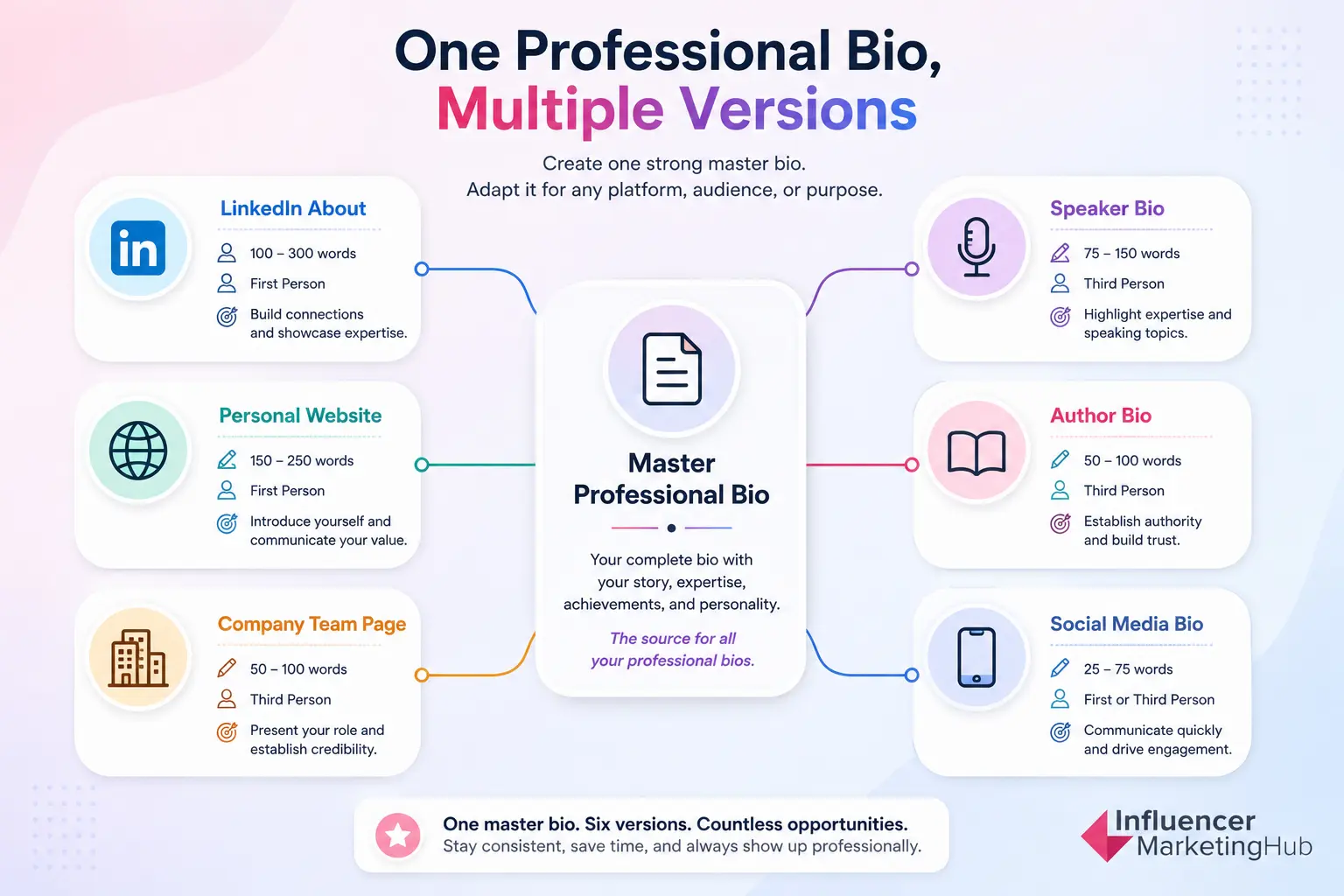
A professional bio isn't something you should rewrite every time a new opportunity comes along. Whether you're updating your LinkedIn profile, speaking at a conference, publishing a guest article, or joining a company website, you're introducing the same professional—you simply need to adjust the format, tone, and length.
The easiest approach is to create one strong master bio and adapt it for different situations. That saves time, keeps your personal brand consistent, and ensures every version communicates the same expertise while meeting the expectations of each platform.
The templates below provide proven structures for some of the most common professional bio formats.
| Template | Best For | Typical Length | Point of View |
| Short Professional Bio | Company directories, networking, introductions | 25–50 words | Third person |
| LinkedIn Bio | LinkedIn About section | 100–300 words | First person |
| Executive Bio | Leadership pages, media kits | 100–150 words | Third person |
| Freelancer Bio | Portfolio websites, proposals | 75–150 words | First or Third person |
| Speaker Bio | Conferences, webinars, podcasts | 75–150 words | Third person |
| Author Bio | Books, guest articles, newsletters | 50–100 words | Third person |
| Student Bio | Applications, portfolios | 50–100 words | First or Third person |
Short Professional Bio Template
- Best for: Company directories, networking events, contributor pages
[Name] is a [job title] specializing in [area of expertise]. [First name] helps [target audience] achieve [desired outcome] through [service or expertise]. Outside of work, [he/she/they] enjoys [personal interest].
LinkedIn Professional Bio Template
- Best for: LinkedIn About section
I'm a [profession] specializing in [specialization]. I help [target audience] achieve [goal] through [skills or services]. Throughout my career, I've [key achievement or experience]. I'm passionate about [professional interest] and enjoy connecting with others in the industry.
Executive Professional Bio Template
- Best for: Leadership profiles, company websites, media interviews
[Name] is the [position] at , where [he/she/they] leads [primary responsibility]. With more than [number] years of experience in [industry], [first name] has [major accomplishment]. [He/She/They] regularly [speaks, advises, publishes, etc.] on [subject].
Freelancer Professional Bio Template
- Best for: Personal websites, proposals, freelance marketplaces
[Name] is a freelance [profession] who helps [target audience] achieve [goal] through [services]. [First name] specializes in [specialization] and has worked with [clients or industries]. When not working, [he/she/they] enjoys [interest].
Speaker Professional Bio Template
- Best for: Conferences, webinars, podcasts
[Name] is a [profession] specializing in [expertise]. [He/She/They] has helped [audience or industry] achieve [result] through [approach]. [First name] regularly speaks on [topics] and is passionate about helping organizations [goal].
Customize Your Bio in Minutes
Writing a professional bio from scratch is only half the job. You'll also need versions for LinkedIn, company websites, conference programs, guest articles, author pages, and more. The IMH Professional Bio Template Library includes editable templates for each of these situations, making it easy to adapt your master bio without starting over.
Button: Download the Professional Bio Template Library
First Person vs. Third Person: Which Should You Use?
One of the most common questions people ask when writing a professional bio is whether it should be written in the first person ("I") or the third person ("she," "he," or "they"). The answer depends less on personal preference and more on where the bio will appear.
First-person bios feel more conversational and are commonly used on platforms where you're speaking directly to your audience. Third-person bios feel more formal and are generally preferred when someone else is introducing you or publishing your biography.
| Situation | First Person | Third Person |
| LinkedIn About Section | ✅ Recommended | Optional |
| Personal Website | ✅ Recommended | Optional |
| Portfolio Website | ✅ Recommended | Optional |
| Company Team Page | Optional | ✅ Recommended |
| Conference Speaker Bio | ❌ | ✅ Recommended |
| Author Bio | Optional | ✅ Recommended |
| Guest Article | Optional | ✅ Recommended |
| Podcast Guest Profile | Optional | ✅ Recommended |
Here's how the same introduction changes depending on the point of view.
First Person
I'm a digital marketing strategist who helps SaaS companies grow through SEO and content marketing. I've spent the past eight years developing content strategies that increase organic visibility and generate qualified leads.
Third Person
Jordan Rivera is a digital marketing strategist who helps SaaS companies grow through SEO and content marketing. Over the past eight years, Jordan has developed content strategies that increase organic visibility and generate qualified leads.
Neither version is inherently better. The right choice is the one that matches your audience's expectations.
How Long Should a Professional Bio Be?
There isn't a single ideal length for a professional bio. The appropriate length depends on where it's being published and how much context readers need. Rather than writing separate bios from scratch, start with a comprehensive master version and create shorter adaptations for different situations.
| Bio Length | Best For |
| 25–50 words | Networking introductions, company directories, contributor notes |
| 50–100 words | Author bios, guest articles, podcast appearances |
| 100–150 words | Conference speaker profiles, company leadership pages |
| 150–250 words | Personal websites, portfolio About pages |
| 250+ words | Detailed About pages, media kits, professional profiles |
As a general rule, use the shortest version that still gives readers enough information to understand your expertise and why it's relevant. Longer bios aren't necessarily better—clarity and relevance matter far more than word count.
Write It Once. Adapt It Everywhere.
A professional bio is one of the few pieces of content that follows you throughout your career. It appears on LinkedIn profiles, company websites, conference programs, guest articles, portfolios, and countless other professional touchpoints. Taking the time to create one thoughtfully pays dividends every time someone wants to learn more about you.
Rather than writing a new bio for every opportunity, start with a strong master version that clearly communicates your expertise, credibility, and personality. From there, adapt it to suit different audiences, platforms, and word limits.
Using the IMH Professional Bio Framework, along with the Professional Bio Builder and Professional Bio Template Library, you'll have a repeatable system for creating polished, professional introductions whenever you need them.
Frequently Asked Questions
What should a professional bio include?
A professional bio should introduce who you are, what you do, who you help, and why you're qualified. Most effective bios also include one or two pieces of supporting evidence—such as experience, achievements, or certifications—and, where appropriate, a brief personal detail that makes you more memorable.
How long should a professional bio be?
The ideal length depends on where it will appear. Company directories may only require 25–50 words, while speaker bios and website profiles often range from 100–250 words. It's best to write one comprehensive master bio and then create shorter versions for different situations.
Should I write my professional bio in first or third person?
First person works well for LinkedIn profiles, personal websites, and portfolios because it feels conversational. Third person is generally preferred for conference speaker pages, company websites, author bios, and media profiles where someone else is introducing you.
What's the difference between a professional bio and a résumé summary?
A résumé summary is written specifically for job applications and highlights qualifications relevant to a particular role. A professional bio is more flexible and introduces your expertise across websites, social profiles, speaking engagements, publications, and networking opportunities.
Can I use the same professional bio everywhere?
You can use the same core information, but you shouldn't use exactly the same version everywhere. Different platforms have different audiences, tone, and length requirements. Creating one master bio and adapting it for each use case is usually the most effective approach.
How often should I update my professional bio?
Review your professional bio at least once a year or whenever you reach a significant career milestone, change roles, earn a certification, publish major work, win an award, or begin offering new services.
What are the biggest mistakes people make when writing a professional bio?
Common mistakes include relying on vague adjectives, listing job responsibilities instead of outcomes, making the bio too long, writing without a clear audience in mind, and using the same version across every platform without adapting it.
Do I need to include personal interests in my professional bio?
Not always. Personal details should only be included if they're appropriate for the audience and help readers connect with you. One short sentence about your interests or values is often enough to add personality without distracting from your professional expertise.